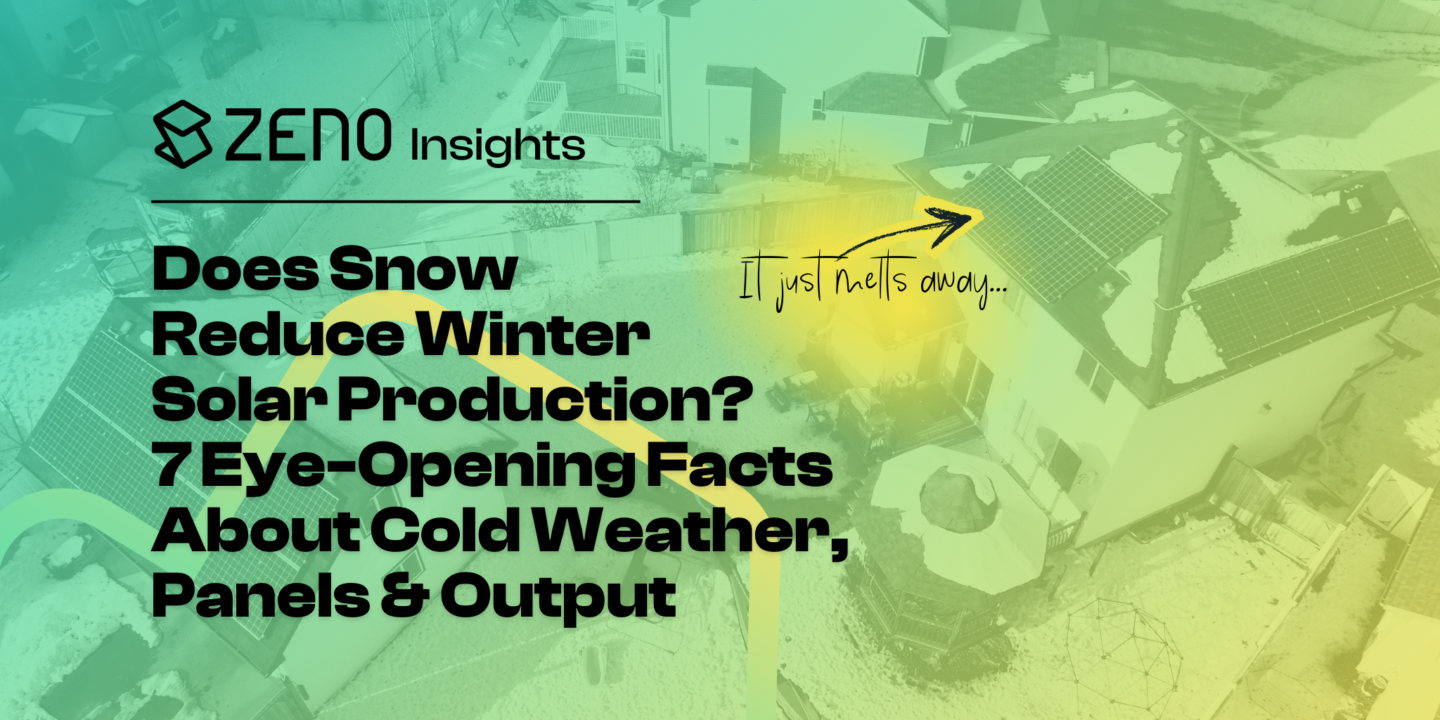
TL;DR – Does snow reduce winter solar production? Snow can temporarily reduce winter solar production, but for most Canadian homes the impact is small and already accounted for in system design. Cold temperatures often improve panel efficiency, snow typically clears on its own, and winter losses do not meaningfully affect annual solar output when systems are properly designed. Solar works year-round in snowy climates like Canada. Snow also tends to occur during the shortest winter days, when overall solar production is already lower due to limited daylight.
Homeowners in colder climates often hesitate before going solar because of winter performance. Snow-covered roofs, freezing temperatures, and shorter days can look like deal-breakers. But real-world data from Canadian research institutions shows that winter solar production is far more reliable than many homeowners expect.
In short, snow can block sunlight while it sits on panels, but it usually clears quickly and does not reduce total yearly solar production enough to make solar “not worth it” in Canada.
This article breaks down exactly how snow and cold weather affect solar panels, when winter production dips, when it improves, and what actually matters for long-term output.
Table of contents
- Why homeowners worry about winter solar production
- Does snow reduce winter solar production?
- How cold weather affects winter solar performance
- What happens when solar panels are covered in snow
- Seasonal solar production explained simply
- When snow meaningfully reduces solar output
- Why cold climates can still be ideal for solar
- Design factors that matter in snowy regions
- Key takeaways: Winter solar performance in snowy climates
Why homeowners worry about winter solar production
Solar panels are often associated with hot, sunny regions, so it’s natural for homeowners in Canada to question whether winter solar production can deliver meaningful results.
Common concerns include:
- Panels being buried under snow for long periods
- Cold temperatures reducing electrical output
- Winter production being too low to justify the investment
- Systems underperforming in harsh conditions
These concerns are understandable, but they’re often based on assumptions rather than measured performance. A CanmetENERGY field study on photovoltaic yield uncertainty in Canadian climates found that while snow can temporarily reduce output, the overall impact on annual energy production is generally modest when systems are properly designed.
Focusing on winter alone often misses how solar systems are designed and evaluated over an entire year. A Free Solar Quote can help you understand how production is calculated and provide an estimate based on full-year performance.
Does snow reduce winter solar production?
Yes, snow can temporarily reduce winter solar production, but typically for short periods and with limited annual impact.
According to the same CanmetENERGY study, snow-related losses are usually a small fraction of total yearly energy generation, even in regions with regular snowfall. The research emphasizes that snow losses tend to be intermittent and are already accounted for in production modeling for cold climates.
The key takeaway is that solar systems are designed around annual production, not worst-case winter days.
How cold weather affects winter solar performance
Another common misconception is that cold temperatures reduce winter solar performance.
In reality, the study explains that photovoltaic modules often operate more efficiently in colder conditions because lower temperatures reduce electrical resistance within the system. This can partially offset seasonal reductions in daylight hours.
On clear winter days, cold temperatures can actually improve electrical output per hour of available sunlight, even though total daily production is lower than in summer.

What happens when solar panels are covered in snow
Snow can block sunlight while it sits on panels, but it rarely stays there for long.
Most residential solar panels are installed at an angle. This helps snow slide off naturally once sunlight hits the surface or temperatures rise slightly. This approach aligns with panel tilt and system design guidance published by Natural Resources Canada
Because panels are dark and absorb heat efficiently, even limited winter sun can help loosen snow and speed clearing, meaning winter solar performance is usually only briefly affected.
Seasonal solar production explained simply
Solar production changes throughout the year, and this is normal.
In winter:
- Days are shorter
- Snow may temporarily reduce output
- Cold temperatures improve efficiency
In summer:
- Days are longer
- Sun angles are higher
- Heat slightly reduces efficiency
This seasonal balance is why Canadian system modeling focuses on total annual energy output, not a comparison of summer versus winter solar production. Solar potential varies by region, as shown in Natural Resources Canada solar resource maps, with southern Alberta consistently ranking among the sunniest areas in the country.
When snow meaningfully reduces solar output
There are cases where snow can have a more noticeable impact.
Snow-related losses are more likely when:
- Panels are installed at very low tilt angles
- Roofs face north or experience heavy shading
- Snow accumulates for long periods without sunlight
- The system was undersized from the beginning
The Canadian photovoltaic yield uncertainty study from CanmetENERGY found that snow losses are generally modest when systems are properly designed, reinforcing that performance issues are usually design-related rather than technology-related.

Why cold climates can still be ideal for solar
Many regions with long winters still see strong winter solar production.
Canadian field observations summarized by the Pembina Institute, a national energy policy research organization, show that snow and cold temperatures do not prevent solar panels from delivering reliable energy over the year.
Cold temperatures, reflective snow, and clear winter skies can all support solar output when systems are designed correctly. Our Solar Savings Calculator can help estimate how those conditions affect production over a full year.
Design factors that matter in snowy regions
Weather matters, but design matters more.
Key design factors include:
- Panel tilt optimized for snow shedding
- Proper system sizing for annual household usage
- Equipment rated for cold-weather operation
- Production modeling based on historical local climate data
Real-world winter performance in Canada has been demonstrated through projects and monitoring programs such as those documented by NAIT, which observed strong solar output despite extreme winter conditions.
Key takeaways: Winter solar performance in snowy climates
- Snow can temporarily reduce solar output, but losses are usually short-lived and modest over the year
- Cold temperatures often increase solar panel efficiency
- Most panels shed snow naturally due to tilt, dark surfaces, and sunlight exposure
- Winter production is lower than summer, but Canadian systems are designed around annual output, not seasonal peaks
- Snow-related losses are typically a design issue, not a technology failure
- Proper panel tilt, system sizing, and local climate modeling matter more than snowfall itself
- Real-world Canadian data consistently shows solar performs reliably in winter
- For most homeowners, snow does not reduce solar production enough to outweigh long-term savings
Solar works year-round in Canada. Understanding how it performs in winter is often all it takes to move from hesitation to confidence. A Free Solar Quote can help you understand what full-year production would look like for your home.